
The city of Charlottesville’s website contains the slogan, “City of Charlottesville: A Great Place to Live for All of Our Citizens.” Through the exploration of Charlottesville’s Downtown Mall we have discovered the opposite. The mall functions as a semi-private space. This has been accomplished by making the Mall an inaccessible space for many members of the low income community. We have found that the mall caters to predominately white, middle and upper middle class patrons through its shopping, transportation accessibility, dining and activities such as a skating rink and theatre rather than catering to “All {Its} Citizens.” We have researched the cost of a day at the Downtown Mall for a family of four without children over the age of five(please see itinerary). Our researched estimate of the total cost of a day at the Mall for a family of four (which includes the cost of transportation, a trip to the skating rink and dinner) ranges from a minimum of $58.00 to upwards of $213.00! The cost display does not even include the cost of gas if the family drives or possible shopping expenses! With 26% of Charlottesville residents living below the poverty we argue that this is not a price that all can afford. This cost makes the Downtown Mall a semi-private space only for those who can afford it.
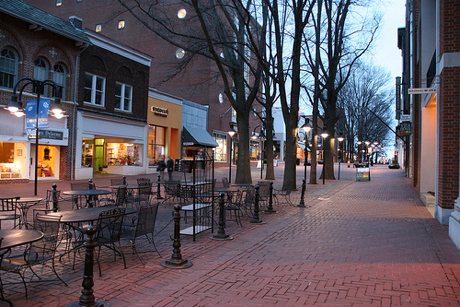
The downtown area of Charlottesville, Virginia during the mid-19th and early 20th century became “the social and commercial heart of the city.” The downtown area was centered on West Main Street. After a century of prosperity the downtown area had a significant decline in business. Around this time the developing suburban centers drained the city of many patrons and caused a significant drop in profit. However, during the 1970s the city decided to make some big changes to the downtown area. They decided to enclose Main Street and create a downtown pedestrian-oriented mall. The city wanted to create a public space thriving with a mixture of businesses, restaurants, clothing retailers, and theaters set along brick streets (www.charlottesville.org). Today the “City of Charlottesville” webpage describes the area as “the social center for Charlottesville Residents.” The city of Charlottesville wanted to create a public space for all, but instead, a publicly funded private space designated only for some was created (www.charlottesville.org).
The idea of a private space can first be seen upon approaching the mall. When going towards the Downtown Mall there only a few signs signifying the presence of the downtown mall. One sign reads “Historic Downtown Mall.” However even with the visible signs, it is difficult to find its entrance unless one has prior knowledge of where it is located. This public space is largely hidden by an array of barriers. When facing the mall, on the left stands the Omni Hotel, to the right is the indoor skating rink, and directly in front is an array of tall trees. Just the presence of these barriers creates a feeling of exclusion in outsiders when visiting the mall. These barriers lead many people to feel as though they have to have a purpose for visiting the downtown mall. The entrance is the first example of how the Downtown Mall creates a private space.
Here is a little background information on the demographics of Charlottesville. These statistics are based upon the 2000 census conducted by the United States government. They can be found at www.factfinder.census.gov. The total population of the city of Charlottesville is just over 45,000. The median household income in dollars is 31,000 and the median family income is 45,110. The number of families below poverty is 935, about twelve percent of the total population, almost three percent above the national average. Twenty-six percent of individuals live below the poverty level, almost thirteen percent above the national average.
Looking at the income demographics of Charlottesville can tell us a great deal about the relationship between the distance of the downtown mall and whether or not it is beneficial to the lower income groups of Charlottesville. As seen on the block map of the city of Charlottesville, there are two main concentrations of below poverty areas. The first is located on the south side of the downtown mall. Their household family income, as of the 2000 census ranged between $15,000 and $19,500. The second low-income area is located to the west of the downtown mall and encompasses the area around Jefferson Park Avenue and the Corner. The majority of the area directly surrounding the downtown mall makes up the lower two income groups. Looking at the main function of the downtown area prior to the pedestrian-mall, its main focus was to provide basic necessities for its residents. However, with the increased costs brought to the pedestrian-mall people living within walking distance cannot even afford basic things provided by the mall.
The second area, as described above, consisting of low-income residents could have predominately-flawed data. This area is consistently made up of college students not working full time. These residents are only living there for eight to nine months out of the year. Many students are still supported predominately by their family’s incomes back home. Therefore as seen on the map it would appear that the free trolley is accessing the lower income neighborhoods, but in actuality it is benefiting the predominately middle-class students present at the University. This point is seen more clearly because once the trolley goes through Jefferson Park Avenue it circles into the actual grounds of the University. The University of Virginia is a public university; however, the grounds have a sense of a private space. An outsider might feel unwelcome to ride the trolley because it goes through this seemingly private space. The idea that UVA is a private space is further seen on the block map because in reality it is not represented by data. Rather the block groups cut around the University campus.
Public transportation and parking at the downtown mall also indicates barriers to non-students and non-vehicle owning citizens of Charlottesville. Although the city of Charlottesville supports a free trolley system for public transport to and from the downtown mall, the free trolley route is not as accessible or as convenient as it could be. Although the route enters some of the lower income areas of Charlottesville, its route essentially consists of various stops that form a loop around the grounds of University of Virginia. Furthermore, the trolleys only extend as far as the downtown mall before returning to the direction of the University of Virginia on the inbound loop of the route. By not entering areas further away from the University of Virginia grounds or beyond the downtown mall itself, the route excludes people who are not students and who live in other areas of downtown Charlottesville.
The Charlottesville Transportation System (CTS) also offers public transportation to other areas of Charlottesville that the free trolley system does not reach; however, people living in the areas not between the University of Virginia and the downtown mall must pay for this transportation. The cost for every round trip on a CTS bus is $1.50 per passenger. Even vehicle-owning citizens of Charlottesville must pay to simply visit the mall, before they have purchased anything at its restaurants, shops, or entertainment venues. A $2.00 hourly fee for either of the parking garages situated near the downtown mall can add up to around $8.00 to $12.00 per vehicle for an afternoon or evening at the downtown mall.
There are a plethora of activities offered at the downtown mall. There are places to shop, dine, sightsee and sleep, but the prices of the individual activities along with the specific characteristics of the businesses offering them do not necessarily uphold the connotation of a mall as a public space. Meals from any of the various restaurants in the downtown mall can either range from extremely expensive to somewhat affordable. Two restaurants located nearby each other on West Main Street are Christian’s Pizza and Downtown Grill. At Christian’s pizza a more expensive meal consisting of 2 large slices of pizza and a drink would cost about $5.50 per person. A slightly smaller meal of one slice of pizza and a drink is only $3.50. In comparison a meal of fried calamari or exquisite crab cakes with a drink would range from $20-$36 with no kids menu available. The research of apparel prices yielded the not so surprising fact that shopping for clothes in the downtown mall is not cheap. A t-shirt from Urban Outfitters typically cost around $20 while jackets may cost around $200 and jeans can range in price from as low as $60 to as high as $200 jeans. In comparison at WalMart a shirt costs about $7 while a hoody costs about $14 and the most expensive pair of jeans costs around $24. The apparel available at the downtown mall in comparison to a more sensible store such as WalMart is much less affordable. While there are less expensive restaurants in addition to higher end ones, clothing prices tend be consistently high. The accumulative cost of enjoying many of the shopping and dining activities available ends up being a substantial amount of money.
The activities at the downtown mall such as the Paramount Theatre and the Skating Rink can be extremely pricey thus furthering the notion that the Downtown Mall is a space that not accessible for all. According to their website, the cost for a family of four to go to the skating rink is $38.00 (this is assuming that the children are over five years of age). This is the same amount of money that many families of this size would spend on groceries for a few days. The rink is only open for public skate at certain times of the day that are not accessible to most working adults. For example, on Tuesday, December 1st the rink is only open for public skate form 12:30pm to 3:00pm. This is also a time that most children are in school. Although the rink is open, having these hours as the only hours for public skate suggests that public accessibility is not a high priority. Early evening hours on this day would probably be the most accessible for the majority of the public. The Paramount Theatre hosts films and performances which can range in price. But the price of some of the events that may be the most appealing can cost an enormous amount. The cost for a family of four to see the Moscow Ballet perform Swan Lake at the Paramount would be $128.00!
The Jefferson Madison Regional library is one of the few free activities located in the proximity of the mall. Although this is a public library we would like to argue that it, like the mall is semi-private because it is not easily accessible to the entire public due to its location. Furthering our notion, the library serves those who have access to it.
Generally, the name mall carries the connotation of a modern public space that is made available to accommodate social and shopping needs. However, the downtown mall of Charlottesville has a seemingly opposite function. The creation of the mall as a public sphere would require it have different facets for individuals from all social classes of the public. However, the prices of the different businesses along with the manor in which they are set up and presented paint the mall as a more private place, only to be enjoyed by those who can afford it. The discouraging of lower class social groups from venturing to the downtown mall is significant because it creates a distinct schism between those of higher and lower social classes. That schism results in the further belittlement of individuals of lower social class which in turn supports their progress away from the unwelcoming private areas.
The Downtown Mall is a semi-private space due to its cost to participate there. But it does not function as so without patronage. Without the patronage the shops, dining and activities would not be able to be able to run. As part of this group that can be classified as patrons or potential patrons of the mall we hope that our project will encourage discourse and challenge perceptions of participation in the structures that exclude some and benefit others. We would like everyone to be aware of the mall’s exclusionary structure and possibly spark ideas in which to change this so it can truly be a “Great Place for All”.
Bibliography
"Calendar_shows_SwanLake10.aspx." The Paramount Theater: Charlottesville's historic Paramount Theater is bringing a world of arts and entertainment to Central Virginia. Web. 06 Dec. 2009. http://www.theparamount.net/calendar_shows_SwanLake10.aspx.
Census. US Government, 2000. Web. 17 Nov. 2009. http://censtats.census.gov/data/VA/390511540.pdf.
"Charlottesville : Fares & Passes." Charlottesville : Home. Web. 18 Nov. 2009. http://www.charlottesville.org/Index.aspx?page=667.
Diversitydata.org. 2000. Web. 17 Nov. 2009. http://diversitydata.sph.harvard.edu/Data/Profiles/Show.aspx?loc=269.
"Downtown Mall Parking - The Charlottesville Movie Fans Meetup Group
(Charlottesville, VA) - Meetup.com." Do something, Learn something,
Share something, Change something - Meetup.com. Web. 18 Nov. 2009.
Downtown Business Association | Charlottesville, VA. Web. 18 Nov.
2009. http://www.downtowncharlottesville.net/stay.html.
Ice Park Home Page. Web. 18 Nov. 2009. http://www.icepark.com.
"Jean Theory - Research." Jean Theory - Home. Web. 18 Nov.
2009. http://www.shopjeantheory.com/research.html.
Jefferson-Madison Regional Library. Web. 06 Dec. 2009. http://jmrl.org/
Saunders, James R., and Ranae N. Shackelford. Urban Renewal And The
End Of Black Culture In Charlottesville, Virginia. McFarland & Company
Inc. UVA Collab. Web. 18 Nov. 2009. https://collab.itc.virginia.edu/access/content/group/99593353-a698-4e6b-9152-1cfaf7ad4348/projects/saunders-shackelford.pdf.
UrbanOutfitters.com Official Site of Urban Outfitters Shop Women's, Men's and Apartment. Web. 18 Nov. 2009. http://www.urbanoutfitters.com/urban/index.jsp.

Itinerary
Cost of a Day at the Charlottesville Downtown Mall
Family of Four Children over 5
ARRIVE
1:00pm Saturday
Transportation
Bus- $6.00
Parking- $12.00
Skating Rink
1:30-3:30pm
$38.00
Shopping
3:30- 5:00pm
$0 window shopping – however much the family decides to spend
Dinner
5:00-7:00pm
Christians: $14.00- $22.00
Downtown Grill: $90.00- $165.00
GO HOME
TOTAL COST: $58.00- $213.00


No comments:
Post a Comment